Spain's PM Points Finger at Traffickers Over 60,000 Migrants
Spain's Prime Minister blamed human traffickers after 60,000 migrants reached Ceuta from Morocco. Most returned by Friday as Italy suspended Schengen agreement.
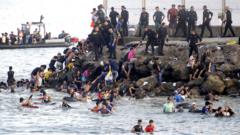
Spain's Government Response to Massive Migration Surge at Ceuta
Spain's Prime Minister addressed the international community following an unprecedented influx of migrants Ceuta Morocco border, with approximately 60,000 individuals crossing into Spanish territory from neighboring Morocco. The government statement placed responsibility squarely on organized human trafficking networks operating across the region, highlighting their role in orchestrating the coordinated movement of such large numbers in a compressed timeframe.
The scale of the arrivals created immediate logistical challenges for Spanish authorities managing border operations. By the conclusion of Friday evening, Spanish officials reported that the majority of the migrants had been processed and returned to Moroccan territory through coordinated bilateral operations. This rapid repatriation effort represented a significant undertaking, requiring extensive coordination between Spanish and Moroccan border authorities and humanitarian organizations.
Italy's Actions and Schengen Framework Tensions
The migration situation at Ceuta triggered broader implications for European Union mobility agreements. Italy responded by initiating a suspension of its Schengen agreement provisions governing free movement with Spain. The Schengen accord, a cornerstone of European integration since 1985, permits unrestricted travel across member nations without internal border controls. Italy's decision to invoke suspension measures reflected mounting tensions over migration management and border security protocols within the EU.
This development underscored the vulnerability of the Schengen system to regional migration pressures. When individual member states perceive inadequate border controls by neighboring countries, suspension mechanisms become available as enforcement tools. Italy's action against Spain demonstrated that even longstanding European agreements face strain when migration concerns escalate to critical thresholds.
Human Trafficking Networks and Border Security
The Spanish Prime Minister's emphasis on human trafficking operations proved significant, as these criminal networks represent a persistent challenge across Mediterranean routes and North African coastal areas. Trafficking syndicates generate substantial revenues by organizing transportation, documentation fraud, and logistical coordination for migrants seeking entry into Europe. The coordinated nature of the 60,000-person movement suggested organized planning rather than spontaneous migration patterns.
Spanish security forces documented the involvement of professional trafficking operatives who had systematized the mass transportation process. Border security agencies identified multiple transportation channels, including maritime vessels and overland routes, all coordinated to maximize the number of arrivals within narrow timeframes. This sophisticated operation highlighted the advanced capabilities of criminal networks operating within the migration sector.
Repatriation Efforts and Friday Evening Operations
Spanish authorities mobilized extensive resources to manage the repatriation process, which accelerated significantly as Friday evening approached. The rapid return of most migrants to Moroccan territory reflected successful coordination between Spanish and Moroccan governments, despite the political tensions the surge had generated. This efficient processing demonstrated Spain's capacity to manage large-scale migration movements through established protocols.
The repatriation operations involved multiple agencies, including national police forces, civil guard units, and immigration authorities. Humanitarian considerations remained central to the process, with organizations monitoring conditions and ensuring vulnerable populations received appropriate attention. Medical facilities screened arrivals for health emergencies before repatriation procedures commenced.
Regional Context and Border Dynamics
The migration surge highlighted persistent tensions along the Spain-Morocco border, where geographic proximity creates constant pressure on Ceuta as an entry point to Europe. Ceuta, a Spanish autonomous city located on the African continent directly adjacent to Morocco, represents the most accessible European territory for migrants departing from North African launching points. Historical patterns demonstrate that migration waves often correlate with diplomatic tensions between Spain and Morocco.
Border security officials noted that the trafficking networks had exploited specific windows of opportunity, suggesting coordination with external actors monitoring Spanish-Moroccan relations. The sophistication of the operation indicated advance planning and resource allocation by criminal organizations with established smuggling infrastructure. This capacity for rapid mobilization poses ongoing challenges for border management strategies.
European Union Policy Implications
The incident carries significant ramifications for EU migration policy and Schengen framework integrity. Italy's suspension gesture signals that member states will increasingly employ available enforcement mechanisms when internal security concerns arise. This development may prompt discussions regarding Schengen agreement modifications and stronger internal border controls across Europe.
The migrants Ceuta Morocco crossing became a focal point for broader European debates about burden-sharing in asylum and migration contexts. Northern European nations grew concerned that southern border states absorb disproportionate immigration pressures, potentially prompting policy discussions regarding collective responsibility mechanisms and resource distribution within the EU framework.